
The global outdoor equipment market is no longer driven solely by aesthetic appeal; it is governed by technical precision and material reliability. For outdoor brands looking to scale, the transition from small-batch production to a long-term partnership with a backpacking tent manufacturer is a critical pivot point. The difference between a high-performance ultralight shelter and a product that fails in sub-zero alpine conditions often lies in the microscopic details of the production line.
Sourcing in this sector requires a shift from “price-per-unit” thinking to “performance-per-gram” analysis. Whether you are looking for wholesale camping tents for a retail chain or a high-end outdoor gear OEM partner for a boutique brand, understanding the engineering behind the fabric is paramount to brand survival.
Table of Contents
Material Integrity in the Modern Tent Factory
A professional tent factory is more than just a sewing floor; it is a high-precision textile lab. When evaluating a potential backpacking tent manufacturer, the first audit point must be the raw material sourcing. High-performance tents rely on low-denier, high-tenacity fabrics, typically Ripstop Nylon or Polyester treated with Silicone (Silnylon) or Polyurethane (PU) coatings.
Technical specifications such as tear strength and hydrostatic head (HH) ratings are non-negotiable. A reliable backpacking tent manufacturer should demonstrate mastery over coating consistency. For instance, according to ISO 811:2018, the hydrostatic pressure test determines the resistance of fabrics to water penetration. In the outdoor industry, a rating of 1,500mm is considered the minimum for “waterproof” status, though elite alpine brands often demand 3,000mm to 5,000mm for floor materials.
Beyond the Fabric: Engineering the Skeleton
The structural integrity of a tent depends on its pole system. Most budget-tier wholesale camping tents utilize fiberglass, but for professional backpacking, 7000-series aluminum or carbon fiber is the standard. An expert outdoor gear OEM provider will have established relationships with specialized pole extruders like DAC or Yunan.
Precision in the tent factory extends to the hardware—YKK zippers, Duraflex buckles, and anodized aluminum stakes. If a manufacturer suggests cutting costs on these “minor” components, it is a red flag regarding their understanding of field-failure risks. A high-quality backpacking tent manufacturer understands that a broken zipper at 4,000 meters isn’t just an inconvenience; it’s a safety hazard.
Customization and Design: The Role of an Outdoor Gear OEM Partner
For brands looking to differentiate, the outdoor gear OEM model offers the best balance of proprietary design and manufacturing scale. This involves more than just slapping a logo on a generic mold. It requires a backpacking tent manufacturer with an in-house R&D team capable of 3D modeling and structural stress analysis.
During the prototyping phase, the manufacturer should provide “golden samples” that undergo rigorous wind-tunnel testing and UV exposure simulations. This is where you determine how to find a reliable backpacking tent supplier for outdoor brands—by their willingness to fail early in the lab so you don’t fail in the market.
Quality Control: Auditing the Tent Factory Floor
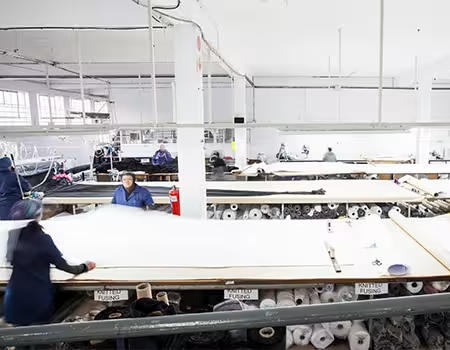
The most crucial step in how to find a reliable backpacking tent supplier for outdoor brands is the physical (or third-party) audit of the tent factory. You must look for “lean manufacturing” markers: organized material storage, temperature-controlled seam-taping rooms, and 100% inspection stations.
Seam sealing is the “Achilles’ heel” of many factories. If the temperature of the hot-air taping machine isn’t calibrated to the specific melting point of the PU coating, the tape will peel within six months. A top-tier backpacking tent manufacturer will have rigorous QC protocols where every batch is tested for seam strength under tension. Reference ASTM D1683 for standard test methods for failure in sewn seams of woven fabrics.
Compliance and International Safety Standards
In the US and EU markets, flammability and chemical safety are legal requirements. The CPAI-84 standard is the most common flammability specification for recreational tents. Any backpacking tent manufacturer you partner with must be able to provide certified lab reports confirming compliance with these regulations.
Furthermore, with the industry moving away from “forever chemicals,” an ethical backpacking tent manufacturer will offer PFC-free (Perfluorinated Compounds) water repellent treatments. This not only protects the environment but also future-proofs your brand against tightening chemical regulations in the European Union under REACH.
Logistics and Scalability for Wholesale Camping Tents
Managing the supply chain for wholesale camping tents requires a manufacturer with sophisticated ERP (Enterprise Resource Planning) systems. Seasonality is a major factor in the outdoor industry; if your backpacking tent manufacturer misses a shipping window in March, you lose the entire spring and summer sales peak.
Reliable suppliers offer transparent lead times—typically 60 to 90 days for mass production—and provide real-time updates on raw material procurement. When you are assessing how to find a reliable backpacking tent supplier for outdoor brands, ask for their historical “on-time delivery” rate and their capacity to handle sudden scale-ups in volume.
Strategic Partnership: More Than Just a Vendor
Ultimately, a backpacking tent manufacturer should be viewed as a strategic partner. They should offer insights into emerging fabric trends, such as the rise of Dyneema Composite Fabrics (DCF) or recycled PET polyesters. A manufacturer that invests in its own future—through automation and sustainability—is one that will help your brand maintain its competitive edge.
The search for the right tent factory is an investment in your brand’s reputation. By focusing on technical certifications, R&D depth, and QC transparency, you move beyond the commodity market and into the realm of high-performance engineering.
Conclusion
Finding a world-class backpacking tent manufacturer requires due diligence that goes beneath the surface. From the precision of the seam tape to the grade of the aluminum poles, every component must be verified. For brands seeking to dominate the outdoor space, the path is clear: prioritize technical excellence over short-term savings. When you secure a partner that excels in outdoor gear OEM services and maintains a state-of-the-art tent factory, you are not just buying a product—you are securing your brand’s legacy in the wild.
FAQ
How can I verify the waterproof rating of wholesale camping tents?
Always request a third-party lab report (SGS or TUV) specifically for the ISO 811 hydrostatic head test. Do not rely solely on the factory’s internal data sheets.
What is the standard MOQ for an outdoor gear OEM project?
Most technical manufacturers require an MOQ of 300 to 500 units per color/model to justify the setup costs for custom fabric runs and specialized tooling.
How do I find a reliable backpacking tent supplier for outdoor brands in a crowded market?
Focus on manufacturers that specialize exclusively in technical shelters. Factories that produce everything from clothing to luggage rarely have the specialized machinery required for high-tension tent construction.