

When the wind howls at 60 mph on an exposed alpine ridge and the mercury drops well below zero, your tent is no longer just a piece of gear; it is your primary life-support system. For many, the transition from summer trekking to winter expeditions is a trial by fire—or rather, a trial by ice. Choosing a 4 season backpacking tent requires moving beyond aesthetic preferences and diving deep into the structural physics of mountaineering.
While a standard shelter might suffice for a breezy autumn weekend, a dedicated 4 season backpacking tent is engineered to handle the brutal vertical loads of heavy snowfall and the lateral shearing forces of high-altitude gales. In this guide, we break down the technical specifications that separate a “winter-ready” label from a true survival shelter.
Table of Contents
Defining the True Winter Camping Tent: Beyond the Marketing Label
What exactly makes a winter camping tent different? It isn’t just about thicker fabric. The architecture of these shelters usually follows a “geodesic” or “semi-geodesic” pattern. By increasing the number of pole intersection points, engineers create a rigid exoskeleton that distributes stress across the entire canopy rather than a single apex.
A high-performance winter camping tent also prioritizes solid fabric over mesh. In a summer tent, mesh promotes airflow; in a winter storm, mesh allows fine “spindrift” (wind-blown snow) to enter the living space, soaking your down sleeping bag and creating a dangerous damp environment. A true 4-season inner canopy uses breathable ripstop nylon to trap a layer of warm air while still allowing moisture from your breath to escape.
Critical Difference Between 3 Season and 4 Season Backpacking Tents for Winter
The most common mistake novice mountaineers make is assuming they can “stretch” a high-end 3-season tent into winter use. Understanding the difference between 3 season and 4 season backpacking tents for winter is vital for safety.
Standard 3-season tents are designed for “shedding” rain and maintaining ventilation. Their poles are usually thinner (8.5mm to 9mm) and are attached via plastic clips. Under a heavy snow load, these clips become brittle and snap, or the thin poles simply buckle. Conversely, a 4 season backpacking tent utilizes continuous pole sleeves. These sleeves distribute the tension of the poles evenly across the entire seam, significantly increasing the total structural burst strength of the shelter.
The Mechanics of Snow Load Capacity: Why Structural Integrity is Life or Death
When you are asleep in the backcountry, a sudden storm can dump six inches of heavy, wet snow in a matter of hours. This adds hundreds of pounds of weight to your canopy. A 4 season backpacking tent is designed with a steep wall geometry to encourage snow to slide off the sides rather than accumulating on the roof.
Snow load capacity is also determined by the grade of the aluminum poles. Professional-grade tents almost exclusively use DAC (Dongah Aluminum Corp) Featherlite NSL or Pressfit poles, typically in 10mm or larger diameters. These alloys are specifically treated to remain flexible in sub-zero temperatures, whereas cheaper fiberglass or low-grade aluminum would shatter under the same snow load capacity requirements.
Thermal Insulation: Trapping Heat in Sub-Zero Conditions
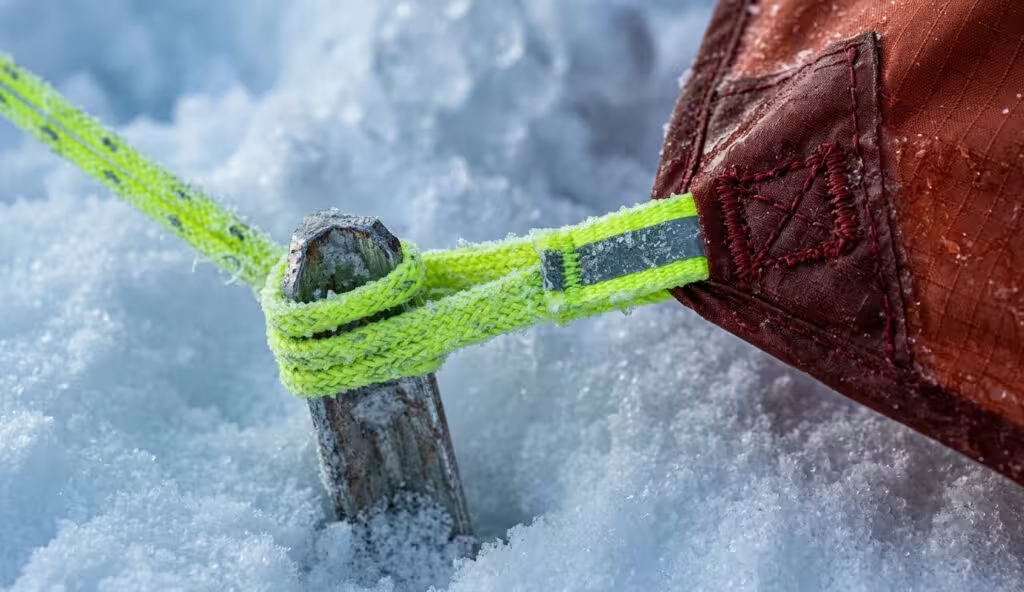
While a tent doesn’t have an “R-value” like a sleeping pad, its ability to provide thermal insulation comes from its dead-air space. A 4 season backpacking tent features a flysheet that extends all the way to the ground, often equipped with “snow skirts”—extra flaps of fabric you can bury under snow to seal out the wind.
This seal is critical for maintaining thermal insulation. By preventing the wind from stripping away the heat trapped between the inner tent and the rainfly, you can maintain an internal temperature that is often 10-15 degrees Fahrenheit warmer than the outside air. However, this requires a sophisticated, adjustable venting system to prevent the “ice cave” effect, where your frozen breath turns into frost on the inner walls.
High-Denier Fabrics and Silicone Coatings (Silnylon)
The fabric of a 4 season backpacking tent must endure extreme UV radiation at high altitudes and the abrasive force of ice crystals hitting the fly at 50 mph. Most expedition tents use a minimum of 40D to 70D (denier) ripstop nylon.
More importantly, these fabrics are often coated with silicone on both sides (Sil/Sil). Unlike cheaper Polyurethane (PU) coatings, silicone doesn’t degrade in UV light and significantly increases the tear strength of the fabric. In technical terms, this relates to the “Elmendorf Tear Strength,” a critical metric for any 4 season backpacking tent.
When is a 4 Season Backpacking Tent Worth the Weight Penalty?
Weight is the enemy of any backpacker. A high-altitude 4 season backpacking tent will usually weigh 50% to 100% more than its 3-season counterpart. You should carry this extra weight if:
- You are camping above the tree line where there is no natural wind protection.
- The forecast predicts sustained winds over 30 mph.
- Accumulating snow is likely during your stay.
For many, the peace of mind offered by a 4 season backpacking tent is worth the extra two pounds in the pack. It is the difference between a restless night of worrying if your poles will snap and a night of deep, recovered sleep before a summit push.
Final Thoughts on Winter Shelters
Selecting the right 4 season backpacking tent is an investment in your safety. By focusing on the difference between 3 season and 4 season backpacking tents for winter, and prioritizing specs like snow load capacity and thermal insulation, you ensure that your gear will perform when the environment becomes hostile.
[View Our Top-Rated 4 Season Expedition Tent Lineup Here]
FAQ
Can I use a 4 season backpacking tent in the summer?
You can, but it will be very hot. The lack of mesh and the ground-length flysheet limit airflow, making it uncomfortable for warm-weather camping.
Is a single-wall or double-wall 4 season backpacking tent better?
Double-wall tents offer better thermal insulation and condensation management. Single-wall tents are lighter and designed for extreme, high-altitude “fast and light” alpine climbs.