
For professional outdoor brands and distributors, the 1 person backpacking tent represents a challenging balance between minimalist weight and structural longevity. Unlike general camping gear, a technical backpacking shelter must operate under extreme constraints, where every gram of fabric and every millimeter of pole geometry is scrutinized. Successful product development in this category relies on precise material sourcing and standardized manufacturing processes to ensure that a fleet of 500 units performs as flawlessly as a single prototype.
Whether you are looking to refine a customized backpacking tent for a niche market or sourcing bulk camping equipment for a professional organization, understanding the intersection of fabric chemistry and mechanical design is essential. This guide deconstructs the architecture of the modern solo shelter, focusing on the metrics that define a market-leading product.
Table of Contents
Technical Specifications: The Fabric of Success
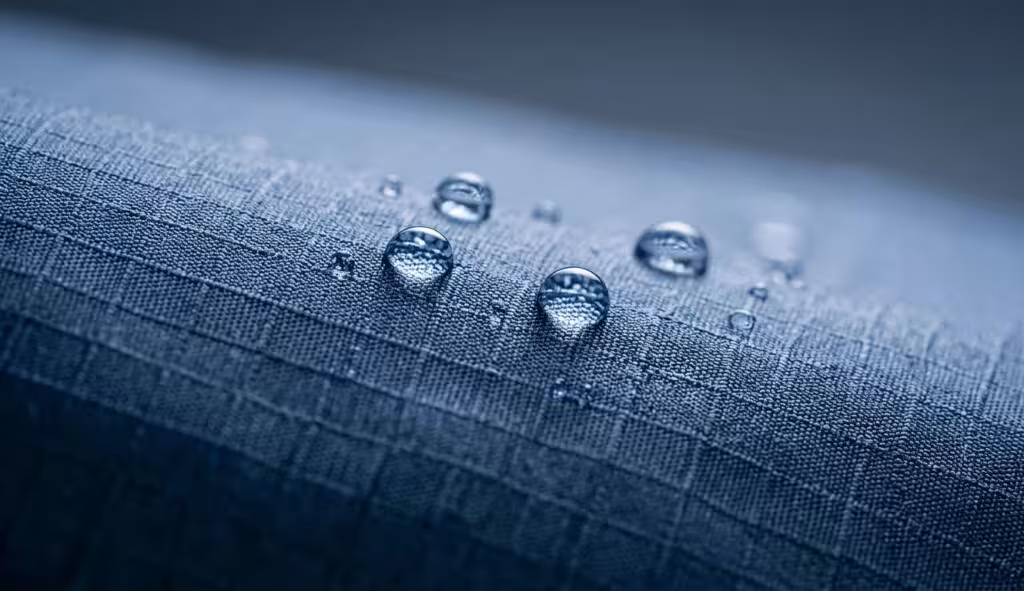
The core value of any 1 person backpacking tent is its protection-to-weight ratio. The choice of the primary canopy fabric—usually between Nylon and Polyester—dictates the entire manufacturing workflow. For high-end applications, a custom 1 person backpacking tent for private label often utilizes 15D or 20D Ripstop Nylon treated with a dual-sided silicone coating (Sil/Sil).
This fabric choice is not just about weight; it is about “Slippage Resistance” and “Hydrostatic Head.” When dealing with technical specifications for ultralight 1 person backpacking tent, we prioritize materials that can achieve a 3,000mm water column rating while maintaining high tear strength. In a professional production environment, maintaining the consistency of this coating across thousands of meters of fabric is the hallmark of standardized quality control for wholesale camping tents.
Structural Integrity and Customization Options
A solo shelter’s geometry must resist multi-directional wind loads without the benefit of a large footprint. This is where customized backpacking tent design becomes an engineering feat. By utilizing DAC or 7000-series aluminum alloys with specific wall thicknesses, manufacturers can tune the flexibility of the frame to the intended environment.
For B-side buyers, the ability to specify “Hub-and-Pole” geometry vs. “Trek-Pole” supported designs allows for significant market differentiation. Scalable production for professional outdoor shelters means having the tooling and templates ready to adapt these frames to different flysheet tensions. This flexibility is a core component of an OEM outdoor gear manufacturing strategy, allowing brands to launch products that are optimized for either high-altitude alpine use or humid lowland trekking.
Comparative Performance Analysis
To facilitate professional decision-making, the following table compares common material configurations used in bulk procurement for 1 person backpacking tent projects.
| Feature Component | Ultralight Series (Elite) | Durable Series (Pro-Summit) | Engineering Advantage |
| Main Fabric | 10D – 15D Sil/Nylon | 40D – 75D Ripstop Poly | Balance of weight vs. UV resistance |
| Poles | Carbon Fiber / 8.5mm Alum | 9.5mm High-Strength Alum | Stiffness-to-weight optimization |
| Waterproofing | Sil/PU (3,000mm) | Heavy-Duty PU (5,000mm+) | Long-term hydrolysis resistance |
| Weight Target | < 900g | 1.2kg – 1.5kg | Market positioning flexibility |
| Customization | Color/Logo/Buckle types | Full geometry adjustments | Scalable brand identity |
Reference: ASTM D737 – Standard Test Method for Air Permeability of Textile Fabrics
Manufacturing Consistency: The “Field Expert” Perspective
One of the most overlooked aspects of the 1 person backpacking tent is the seam sealing process. In a mass-production context, manual seam taping is a point of potential failure. Professionals look for “Factory Taped Seams” or “Liquid Sealed” joints. When a brand requests a customized backpacking tent, they are often evaluating the factory’s ability to maintain a consistent 20mm tape width with zero heat-distortion on the underlying fabric.
This level of detail is what separates a heavy-duty shelter fabric from a generic budget alternative. Field testing in high-wind environments, such as the Scottish Highlands or the Appalachian Trail, proves that a tent’s lifespan is determined by its “Stress Points.” Reinforced bartacking on guy-out points and the use of YKK #3 or #5 water-resistant zippers are non-negotiable requirements for standardized quality control for wholesale camping tents.
Strategic Sourcing and Lead Times
In the current global landscape, bulk procurement for 1 person backpacking tent involves more than just selecting a model from a catalog. It involves managing the OEM outdoor gear manufacturing timeline, from fabric weaving to final QC inspections. For organizations seeking a custom 1 person backpacking tent for private label, the integration of the design phase with the raw material supply chain is crucial.
Professional buyers prioritize factories that offer “Transparency in Sourcing.” This includes the ability to trace the origin of the aluminum in the poles and the chemicals used in the DWR (Durable Water Repellent) coatings. As the industry moves towards PFC-free finishes, ensuring your ultralight shelter wholesale partner is compliant with modern environmental regulations is a key competitive advantage.
Conclusion
The development of a premier 1 person backpacking tent is a meticulous process that begins in the lab and ends in the hands of an adventurer. For brands and wholesalers, the focus must remain on the durability of the geotextile-like membranes (in terms of technical fabrics) and the precision of the assembly.
The development of a premier 1 person backpacking tent is a meticulous process that begins in the lab and ends in the hands of an adventurer. For brands and wholesalers, the focus must remain on the durability of the geotextile-like membranes (in terms of technical fabrics) and the precision of the assembly.
FAQ
What is the minimum order quantity (MOQ) for a customized backpacking tent?
Typically, for full geometry changes, MOQs start at 300–500 units. For simple color or logo changes on existing templates, many OEM outdoor gear manufacturing partners offer lower thresholds.
Can the hydrostatic head be adjusted for specific climates?
Yes. For desert environments, we focus on high UV stabilization and ventilation, whereas for tropical rain environments, we increase the PU coating thickness on the heavy-duty shelter fabric to 5,000mm.
How is weight consistency maintained in bulk camping equipment?
We use precision digital cutting systems and standardized fabric rolls. Weight is monitored at every stage—from the raw fabric to the final packaged 1 person backpacking tent—ensuring a variance of less than 3%.